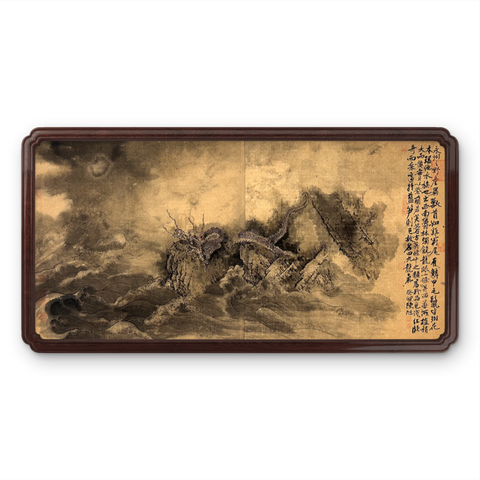
During the Chinese Spring Festival, when you visit temple fairs, you can always see colorful dragon lanterns weaving through the crowds. On the Dragon Boat Festival, people hold dragon boat races—dozens of people row together in harmony, and the dragon head cutting through the waves looks especially majestic. The dragon, a creature often seen in Chinese mythological TV dramas, has become the most familiar "spiritual totem" of the Chinese people.
1. Why Does the Dragon Look Like This?
Have you ever wondered why the dragon has such a complex appearance—"deer antlers, horse face, snake body, fish scales, and eagle claws"? In fact, the dragon's image didn't take shape overnight. It's a "super mythical beast" pieced together by ancient Chinese people.
Thousands of years ago, ancient Chinese people lived in different tribes, and each tribe worshipped its own animal. Some tribes lived by hunting and revered the fierce tiger; some lived by rivers and regarded fish as gods; others admired deer for their speed and strong vitality, so they took deer as their totem.
Later, as tribes gradually merged, wise people wanted to unite everyone. They took features from each tribe’s totem and combined them: deer antlers for dignity, a snake body for good swimming, eagle claws for skillful hunting, fish scales for protection, and finally a horse face for gentleness. In this way, they created the "all-powerful" dragon image.
Scientific finds show that over 6,000 years ago, people unearthed a jade pig-dragon at the Hongshan Culture site. This is the earliest dragon-shaped artifact found so far. Its body resembles a coiled snake, but its head has pig-like features—it's like a "semi-finished product" of the early dragon image. After thousands of years of evolution, the dragon finally took the form we see today during the Tang and Song dynasties.
2. Why Do Chinese People Love Dragons?
The dragon has become a "top star" of Chinese culture thanks to its "superpowers," which exactly match the simplest wishes of ancient Chinese people.
Its most amazing ability is "controlling wind and rain." In ancient China, farmers relied entirely on the weather for their crops. If there was a drought, the crops would fail completely. The legend that dragons live in deep seas or clouds and can bring clouds and rain became a spiritual sustenance for people to fight natural disasters.
Every time there was a drought, people would hold "dragon-worshipping ceremonies." They would place offerings and dance with dragon lanterns, praying to the Dragon King for rain. Even today, people in some places still keep the custom of "Dragon Head-Raising Day."
On the second day of the second lunar month, they get haircuts and eat "dragon beard noodles." They hope that the dragon will wake up, bring spring rain, and bless them with a good harvest for the year.
Besides controlling the weather, the dragon is also a symbol of "power and good luck." In ancient China, emperors called themselves "true dragons' sons." They wore dragon-patterned robes (called "dragon robes"), had dragons carved on palace pillars, and even their beds were called "dragon beds." The dragon became an exclusive symbol of imperial power.
For ordinary people, the dragon represents good fortune and strength. For example, parents name their children "Little Dragon" or "Jade Dragon," hoping that their kids will be as strong and brave as dragons. During the Chinese Spring Festival, dragon dances are performed—when the dragon head sways and the dragon body twists, the lively scene drives away bad luck and ushers in peace and smoothness for the new year.
3. Common Dragon Elements in Life
In traditional Chinese art, the dragon is even more of a "regular guest." Paper-cut artists can cut out flying dragons with just a pair of scissors. The layers of scales make it seem like the dragon will soar into the sky in the next second. Embroidery girls stitch dragons on silk with colored threads—gold and silver threads match perfectly, showing both the dragon's dignity and agility.
The dragon also holds an important position in China's 12 Chinese zodiac signs. People born in the Year of the Dragon are often said to be "blessed" and "energetic"—this is the influence of dragon culture.
What's more interesting is that the dragon has become China's "cultural calling card." At international events like the Olympic Games and the World Expo, dragon images often appear in performances and decorations. In Chinatowns in the United States, dragon dance teams always attract countless eyes when they appear during the Chinese Spring Festival.